

For the founders of Jamu Sehati, Sofyan and Onet, falling in love with jamu was not an instant experience or love at first sight. It was a journey that unfolded over many years, eventually leading them to realize that jamu would become an essential part of their lives. The path was far from easy. Like a marriage, their relationship with jamu has gone through many seasons—sometimes sweet, sometimes sour, and sometimes bitter. Together, these experiences shaped a love story that ultimately inspired her to help build Jamu Sehati into something greater and dedicate herself to sharing the benefits of jamu with others.
Their story began in 2015, when they were invited by Onet’s former boss to help prepare and sell jamu at a floating market in Bandung. At the time, they did not yet have a brand. They simply bottled freshly made jamu and sold it directly to customers. Over time, however, their purpose evolved because of a personal health challenge. In 2016, Sofyan suffered from severe sinusitis for nearly two months. Conventional pharmaceutical treatments failed to provide lasting relief, prompting him to explore herbal medicine more seriously. Eventually, he found that jamu was the most effective remedy for his condition. Together with Onet, he began drinking herbal formulas regularly—the same recipes they now offer to their customers.


Recovery did not happen overnight. It required consistency, patience, and a commitment to drinking jamu while adopting healthier lifestyle habits. Gradually, Sofyan’s health improved. His immune system became stronger, he stopped getting sick as often, and his sinusitis never returned. This experience became a defining turning point—not only for his health but also for the direction of their lives as husband and wife and as business partners.
Sofyan was the visionary behind the idea and the person who came up with the name Jamu Sehati. The name reflected his belief that they should build the business sehati—literally, “one heart” or “of one heart.” It was a simple yet meaningful expression of their shared commitment, partnership, and love.
As time passed, Onet became increasingly immersed in the journey. What began as simply helping to run the business gradually turned into genuine curiosity and, eventually, a deep passion for herbal medicine. She dedicated herself to learning, exploring, and understanding the traditions and knowledge behind jamu. Over time, it became much more than a business. It became something she truly believed in and wanted to preserve. More importantly, the journey helped her reconnect with her identity as an Indonesian and, more specifically, as a Javanese woman.
In many ways, the story of Jamu Sehati reflects the complementary roles of its founders. Sofyan was the visionary who imagined what the business could become, while Onet was the executor who brought that vision to life. Together, they transformed a personal healing journey into a mission to introduce more people to the enduring wisdom of Indonesia’s herbal tradition.
Seeing the opportunity in introducing jamu to a wider audience, they began selling it more regularly through monthly pop-up stores. To their surprise, the response was overwhelmingly positive. They discovered that many people in Bali were interested in this particular Indonesia’s traditional herbal drinks. More often than not, their products sold out whenever they organized a pop-up event in Canggu and other parts of the island. This early success encouraged them to take a bigger step. In 2017, they opened a small kiosk, more of a humble stall than a shop, where they could sell jamu daily. With limited resources but a strong sense of purpose, they turned their dream into reality. Bottled jamu, still without sophisticated branding or label designs, became their way of sharing the goodness of Indonesia’s rich herbal heritage.
As time passed, more and more people visited the kiosk. Many of them were foreigners living in Bali or visiting on holiday. One day, they were approached by a Finnish workshop organizer who invited them to conduct a jamu workshop at Katamama, the boutique hotel within Potato Head in Seminyak. The workshop proved to be a significant milestone for Jamu Sehati. Its success led to a deeper collaboration with Potato Head, where Onet and Sofyan were invited to serve as consultants in developing the group’s jamu offerings. That opportunity changed everything.
“Being trusted by a well-known brand such as Potato Head made me question my own confidence,” Onet recalls. “After all, I did not have an educational background that would establish me as a jamu consultant. At the same time, I felt a tremendous sense of energy and motivation. I knew this challenge could transform our lives if we approached it seriously.”
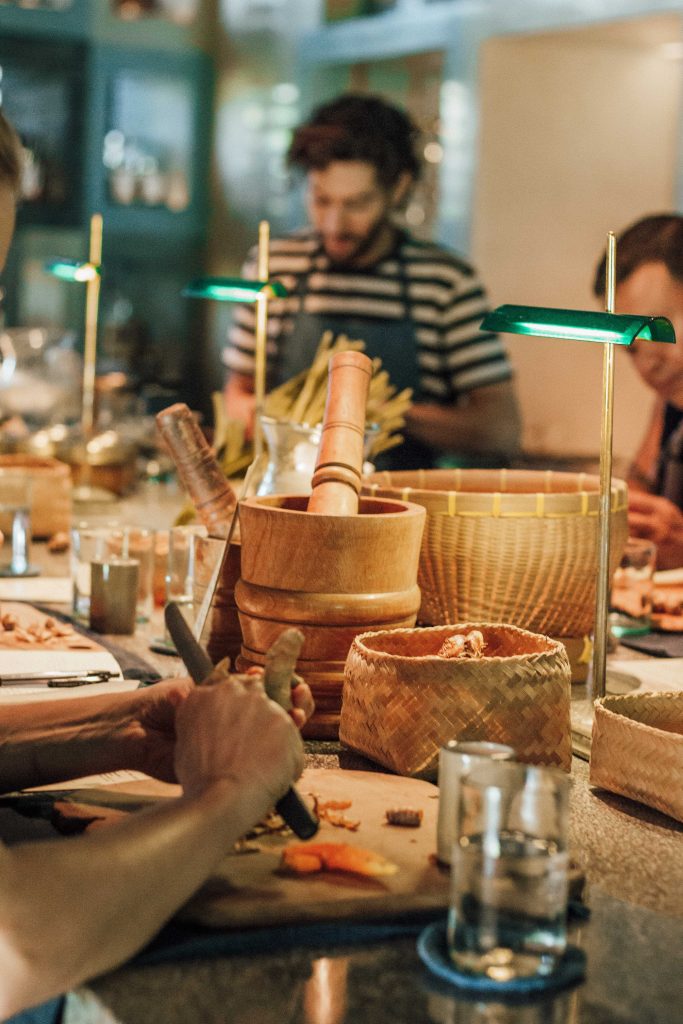
From the moment they agreed to collaborate, Onet immersed herself in the world of jamu. She understood that being a consultant was not simply about teaching recipes—it was about understanding the history, philosophy, and cultural significance behind them. As she dedicated more time to studying jamu, her appreciation and love for it continued to grow.
“When I decided to absorb as much knowledge about jamu as possible, something within me seemed to unlock,” she says. “Interestingly, the process helped ground me. Somehow, it felt like a reminder to return to my roots, to remember who I am as a Javanese and as an Indonesian with ancestors, traditions, and a rich cultural heritage. In the end, my search for jamu was not about finding ancient recipes. It was about finding myself.”
Their exploration eventually led them to Yogyakarta, where they met a legendary jamu maker named Ibu Tari, whose knowledge had been passed down through years of experience and practice. There, they tasted jamu prepared by her own hands. Shortly afterward, their bodies reacted. They experienced fever-like symptoms and diarrhea. At first, the reaction was alarming, but they later learned that it was part of a cleansing process intended to help the body eliminate accumulated toxins. Not long after, they felt remarkably refreshed and energized.
Their visit with Ibu Tari became a turning point. Beyond the experience itself, she shared invaluable knowledge about jamu-making: the techniques, ingredients, preparation methods, and tools behind every recipe. Those lessons became the foundation of their own work, allowing them to recreate not only the flavors of traditional jamu but also the wisdom and benefits embedded within it.
Yet the experience that made Onet truly fall in love with jamu came from an unexpected source: a journal about Borobudur. One section of the journal described how our ancestors infused meaning into everything they created, expressing their wisdom through symbols. According to the journal, the human life cycle can be understood through different jamu ingredients and recipes.

At birth, life is symbolized by turmeric in kunyit asem (jamu drink combining turmeric and tamarind). Turmeric is one of the gentlest and most approachable rhizomes, and kunyit asam is often considered one of the most pleasant and comforting jamu drinks. It represents a phase of life when we are surrounded by love, care, and protection. As we grow into childhood, the symbol shifts to kencur (aromatic ginger) in beras kencur (jamu drink consisting of rice milk and aromatic ginger). Its naturally sweet aroma and flavor reflect the joy, innocence, and carefree nature of being a child. At this stage, life is still lighthearted and full of wonder.
Adolescence and early adulthood are represented by ginger. Unlike the earlier ingredients, ginger carries a distinct spiciness. As we mature, we begin to experience the “heat” of life—the challenges, disappointments, and complexities that come with growing up. The sharpness of ginger becomes a metaphor for these first encounters with adversity.
The journey into adulthood, roughly between the ages of twenty and fifty, is symbolized by bitter herbs such as temulawak (big curcuma), white turmeric, sambiloto, and brotowali. Through these ingredients, our ancestors conveyed a profound truth: bitterness is an unavoidable part of life. Struggles, setbacks, and hardships are not exceptions to the human experience—they are essential parts of it.
Then comes later life, in our sixties, seventies, and beyond. This stage represents wisdom and maturity. The jamu associated with this phase is lighter and clearer, such as uyup-uyup or simple herbal infusions made by boiling ingredients and adding a touch of honey. The concept is clarity. After moving through the sweetness, spiciness, and bitterness of life, we arrive at a state of understanding and acceptance. This phase prepares us to return to where we began—to the universe itself—completing the cycle of life.
This philosophy of jamu as a reflection of the human journey is what truly made Onet fall in love with it. “Our ancestors used jamu not only as medicine,” she says, “but also as a symbolic representation of the human life cycle.” What began as curiosity evolved into a much deeper appreciation of jamu—not simply as an herbal drink, but as a living philosophy that mirrors the entire human experience.
As Onet and Sofyan’s understanding of jamu deepened, they encountered an unexpected challenge: introducing it to modern Indonesians. The biggest obstacle was surprisingly simple—taste. For many Indonesians, jamu is associated with bitterness and unpleasant flavors. The moment they hear the word jamu, they imagine something difficult to drink. Generations have grown up believing that if something is good for your health, it must taste bad.
After learning from traditional masters and immersing themselves in the craft, they began asking a different question: What if they could preserve the benefits of jamu while creating flavors that people genuinely enjoy? Their goal was never to change the essence of jamu. They wanted to preserve the integrity of the ingredients, recipes, and their efficacy while creating a more balanced flavor profile. They wanted to challenge the perception that herbal drinks must be bitter and that wellness must come with discomfort.
Through countless experiments and refinements, they eventually developed their first four formulations: Balance, Yellow Detox, Ginger Tamarind, and Energy. These four products became the foundation of Jamu Sehati. Yet creating delicious jamu was only the first challenge.
The second challenge was changing the way people think about health itself. Unlike many forms of modern Western medicine, jamu is not designed to deliver instant results. Its benefits are often gradual and cumulative, becoming noticeable through consistency rather than immediacy. This makes it fundamentally different from the way many people approach healthcare today. When people have a headache, they take a pill. When they catch a cold, they look for medicine that can eliminate symptoms as quickly as possible. Most people have become accustomed to solutions that provide immediate relief.
Jamu follows a different philosophy. Its greatest value lies not in treating illness after it appears, but in helping the body maintain balance before illness arises. Its effects are gradual, but they are rooted in prevention rather than reaction. This is why one of Jamu Sehati’s greatest challenges has been encouraging people to consume jamu regularly—not only when they feel unwell.
“We believe that the true power of jamu emerges when it becomes part of everyday life,” Onet explains. “Rather than being viewed as a remedy for sickness, it should be seen as a daily practice that supports long-term wellbeing. In many ways, our mission extends beyond selling herbal drinks. What we are really trying to share is a different perspective on health. Today, many of us live in a cycle of treatment rather than prevention. We focus on eliminating symptoms but rarely pause to understand why those symptoms appeared in the first place. We reach for medicine when pain comes, but often overlook the habits, stressors, and imbalances that contributed to the condition. We believe that mindset needs to evolve.”
A healthier lifestyle begins with understanding the root causes of illness and making conscious choices that help prevent it. Prevention may not be as dramatic as treatment, and its benefits may not be immediately visible, but it creates a stronger foundation for long-term health. That is the message Jamu Sehati hopes to share with more people.
Through jamu, Jamu Sehati seeks to promote a healthier and more mindful way of living—one that embraces natural ingredients, patience, and consistency. The process may not be instant, but meaningful health rarely is. At the heart of this philosophy are the spices and botanicals that have been part of Indonesian culture for generations. Many of these ingredients possess natural anti-inflammatory properties. This is particularly important because inflammation can affect countless systems within the body, from cells and tissues to circulation and overall bodily function.
For centuries, our ancestors understood this connection. They recognized that the ingredients growing around them were not merely food or flavoring, but tools for maintaining balance and resilience. In a world increasingly driven by quick fixes, Onet sees jamu as an invitation to return to a more thoughtful relationship with health—one that values prevention as much as treatment, and daily wellbeing as much as recovery. Reflecting on her journey, she concludes, “Ultimately, our goal is not simply to make people drink jamu. It is to inspire a lifestyle where wellness becomes a daily practice, where health is nurtured before it is lost, and where the wisdom of our ancestors continues to serve future generations.”
Back to the roots